
Bon Game Reserve
Every bridge has a story – Part 2
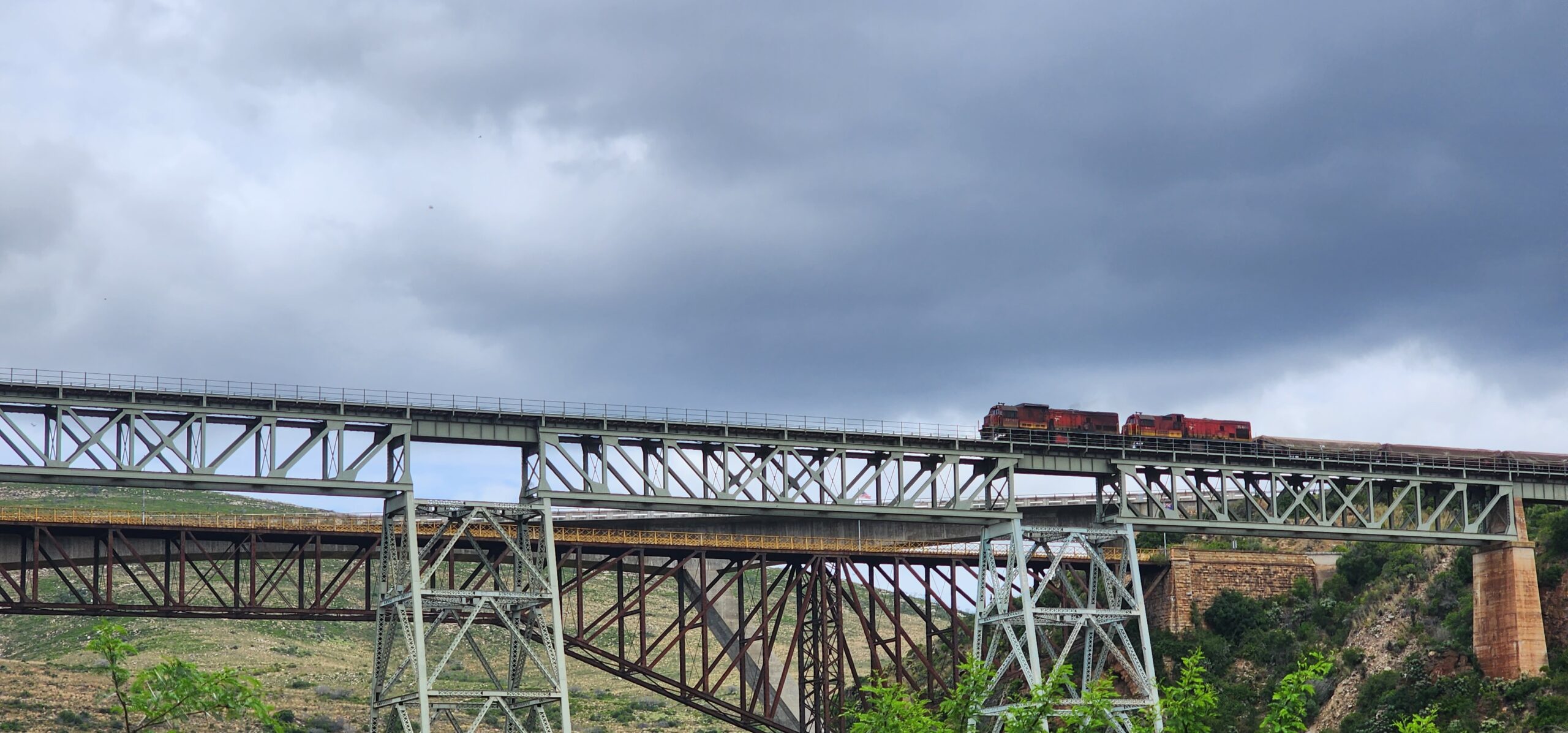
Opened to the public on 30 March 1892, this bridge was designed by Sir Benjamin Baker. It was built as a road bridge, but in 1906 it was converted to dual use when the private New Cape Central Railway was allowed to lay their tracks across the structure, probably loading it far more than it was originally designed for. This adaptation required strict operational conditions, including a maximum train speed of approximately 13 km/h to ensure safety on the narrow deck, which was only five metres wide.
The ironwork for the cantilever structure spans 214 metres and it was a significant engineering feat of its time. Spanning the gorge at a height of approximately 60 metres, the bridge’s construction presented significant engineering challenges. The use of the ‘Blondin’ overhead cableway system, previously employed on the Orange River Bridges, facilitated the transportation and placement of materials across the expansive gorge during construction.
The parts for this bridge were manufactured by Andrew Handyside & Co. Ltd. at their Britannia Iron Works in Derby, England. The bridge parts would have probably been transported via England’s railway network to a sea port for shipping to South Africa.
For nearly 40 years, this single-track bridge accommodated both road traffic and railway trains until 1931, when a separate railway bridge was constructed.
In an article in the June 1973 The Civil Engineer in South Africa journal, a road engineer recounted the following interesting information and personal experiences relating to the bridge: The procedure when a passenger train crossed the road bridge between 1927 and 1931 was very strict. Because of the weight limit imposed, the trains over the section were always drawn by two comparatively small and therefore light engines, still much heavier than the ox-wagons for which the bridge had presumably been designed.
When a train approached the bridge, the road traffic was stopped by the closing of gates and the whole train itself also came to a stop just short of the bridge. After being uncoupled, the front engine would then cross very slowly by itself. When all vibrations had ceased, the second engine, with the coaches behind it, would literally crawl across the structure until the engine was once again on terra firma, but the coaches were still on the bridge.
Here another stop was made while any vibrations which had been set up could stop and while the first engine was again coupled to the rest of the train. Eventually, very slowly, the train was set in motion, the coaches were drawn off the bridge and the train proceeded up the steep approach.
Unfortunately, photographic evidence of this unique dual-purpose process appears to be scarce or non-existent today. The absence of such photographs could be attributed to the limited availability of photographic equipment at the time, the challenges in capturing moving subjects, or the possibility that existing photographs have just not been digitised or widely circulated.
Leave a Reply